

| |
| Elderly Drivers, One Last Hope by: Tim Phillippi Editorial
At www.nhtsa.dot.gov/people/ncsa/pdf/Older98.pdf the National Highway Traffic Safety proclaims 17.7 million licensed elderly drivers. The truth is, baby boomers are turning gray and the Federal Interagency Forum on Aging-Related Statistics reports.the number of people behind the wheel who are older than 65 will more than double by 2050 reports. Recent research shows that teens and seniors share the highest accident rates. When adjustments are made for miles driven, drivers between 75 and 79 are twice as likely as the average driver to be at fault in a fatal collision. Drivers 80 to 84 are six times as likely, and drivers over 85 are 10 times as likely. Coming-of-age as an older American comes with baggage; whether it's visiting grandchildren or giving an extra effort to go exercise, to health threats like osteoporosis, a deterioration in bones due to the lack of calcium, effecting more than 24 million people, or the gradual threat of a loss of vision and memory, older Americans need transportation. And since these studies show, in 1998 the percentage of older adults with moderate or severe memory impairment ranged from about 4 percent among persons ages 65 to 69 to about 36 percent among persons age 85 or older, they need regular check ups even if they appear to in good health, because they know, in the back of their minds, their world is shrinking and they won't have their independence to do something simple like driving to church only a mile away. So tensions will arise because of refusal to give up their keys or lack of family members being able to help out. Local help has arrived with the joined hands of Eddie C. Crow, program manager at Penn State's Applied Research Laboratory and Dennis Foderberg the director at the Center for Transportation Studies. Combined, they will direct a new effort, known as the Partnership for Safety, Unrestricted Mobility and Access (PSUMA). Rural living translates into a sole dependency on cars since other options, like public transit, often don't exist. "While our new program is designed primarily for older drivers in Pennsylvania and Minnesota, the results of these studies will be applicable to aging Americans throughout the U.S.," Foderberg says. The only actions on the horizon from Penn State and Minnesota are developing ways for older citizens to determine proactively and plan for future mobility needs and the means to get around in order to maintain an active and high quality lifestyle. Since the growing number of elderly Americans is inevitable, it creates a vast majority of people who have impaired lives. And since there are no new technological advances that prevents the elderly from getting hurt easily I ask you as a reader to help. Remember you have a right to get somewhere and you can did it one of two ways, help by personally driving your grand mothers and fathers or contact your state representatives or congressmen to help fund PSUMA and help save the elderly drivers. |
 Read More Articles Read More Articles |
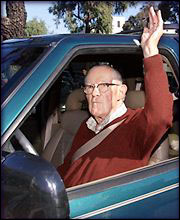 Imagine this. Your best friend, I'll call that person Alex, is riding with you while you're driving through the streets of suburbia. As you are listening to "new music" on the radio, you have a Jeff Gordon experience avoiding a gradually moving vehicle. Granted they were going slow because you were traveling at breakneck speeds, 3-7m.p.h. over the posted 35m.p.h. limit. "Is that guy still back there?" You ask nudging Alex. "Yeah," he responds. He begins to reposition himself, "I'm going to dedicate that guy a piece of..." What, why did he stop? "Alex?" A pause, then a burst of laugher and bunch of mumbling comes out of Alex, "I...back there...nobody...fuzzy steering wheel!" He recovers and begins to preach, "But seriously how many elderly drivers are out there, aren't they just hurting themselves? Is there even any laws regulating them from being on the road, and what can I do to help commuters in danger?"