

| |
| Rockabilly: What is it, and where can you find it? by: S. R. Michaud Hard News
A shiny '57 Chevy with flames on the hood is parked in front of the club. Welcome to the rockabilly scene 2000. With the swing page off the front page of the feature section, and left behind by MTV, local dance floors haven't completely emptied. A small, devoted group holds on. These are the "rockabillies." For the guys, standard-issue dress includes cuffed jeans, pointed shoes and tattoos, and greased hair with long sideburns. The women, with fancy vintage dresses and elaborately styled hair, look like '50s pin-ups. These rockabillies form a scene in which the music is the common pulse. "I can't listen to the radio today," said Greg Huff, AKA Lazy Ike, of the local band Lazy Ike and the Daredevils. "It's all over-produced op, computer-enhanced drivel that has no emotional impact. Rockabilly is real. Even though some people may think we're living in the past, we're celebrating a time and a feeling that is more real to us." According to Huff, rockabillies like real bars, real drinks, and real rock-n-roll music. "Lee's is the top for rockabilly," wrote Neal Justin, a TV critic and feature writer for the Star Tribune, in his Experts column Sept. 22. Lee's features local acts such as The Vees (comprised of Bobby Vee's sons), Trailer Trash, The Vibro Champs and Lazy Ike and the Daredevils, as well as national acts such as Deke Dickerson and the Ecco-Phonics, Big Sandy and the Fly-Rite Boys, and Ronny Dawson, to name a few. Trailer Trash, a honky tonk band, can take some credit for helping to start the scene at Lee's when six years ago, they began having a local dance instructor give lessons at their now legendary Wednesday night shows. But what is rockabilly? Is it the same as rock and roll? Billy Poore, in his book RockABilly, A Forty-Year Journey described it best. Dave Wolfe, of the quartet The Vibro Champs, described it more simply. |
 Read More Articles Read More Articles |
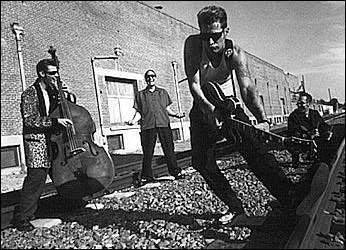 The men wear pompadours, thick with grease.